
Learning Center · Graded-card buying
How to Inspect a Graded Card and Its Slab Before Buying
Buying a graded card changes the inspection question. The card is sealed, so you cannot check its surface directly; you are judging what the photographs show through plastic, whether the label and certification record agree, and whether the holder itself is in acceptable condition. Start with clear full front and back views of the entire slab. Then request close views only for a specific area that affects your decision. Neither a photograph nor a matching certification number alone authenticates the object in front of the camera.
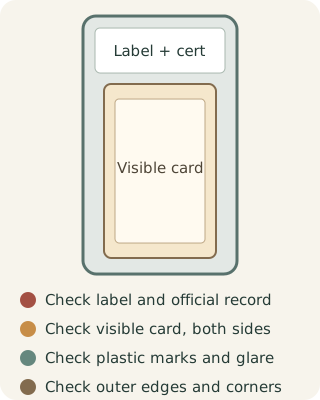
Identify the card and the holder separately
Read the label without guessing from a small thumbnail. Check the name, year, set, card number, variant, grade, and certification number against the seller's description. Some labels use abbreviations, and the holder may hide part of the card's own identifying text. If the listing says one version but the label or visible card appears different, ask for a clearer label and card view before interpreting condition. An identity mismatch is a separate question from a scratched holder.
Look at the full slab perimeter in both photos. A tight crop can omit a chipped corner or an area of clouded plastic. Ask whether the photographs show the card's front and back through the holder, not just the label and a dramatic angled shot. A slab may look clean at the label while glare covers the card's most important surface. Keep three notes: what the label says, what the visible card shows, and what the outer holder shows. Do not let a grade on the label erase a visible question about the item you would receive.
Use the grader's official certification lookup
When the grading company offers a public lookup, enter the number from the photographed label in that company's own tool. For a PSA-labeled card, use PSA Cert Verification and compare the returned identity and grade with the listing. If the company displays reference images or other record details for that item, compare them where available; do not assume every record has the same information. A mismatch calls for clarification before buying. If the lookup does not return a matching record, recheck the certification number and ask the seller for clarification. Do not guess why the record is missing from one failed search.
PSA states that certification-number verification does not eliminate risk: its database confirms information associated with a number, while PSA does not inspect the particular web listing you are viewing. A real number can be copied into a misleading listing. This is why a lookup is one check in a larger evidence set, not a certificate that the photographed slab and card are genuine. Follow the relevant grader's current official instructions for any other label. Do not rely on a third-party screenshot of a lookup when you can inspect the official record yourself.
Inspect the holder as its own object
View the front and back plastic at more than one angle. Note scratches, scuffs, chips, cracks, haze, internal-looking debris, and areas that appear cloudy. A fine scratch on the outside may matter mainly to display value; a deep crack or a flaw that blocks the card view may matter much more. Describe the visible location and extent rather than assuming how the holder got that way. A bright edge reflection can imitate a fracture in one image, so ask for an angled close-up when the distinction matters.
Check whether the full slab edges and corners are visible. A single frontal photo often hides shallow scratches; an angled photo can expose them but may also replace card detail with glare. Compare the same area across views. The card-versus-holder mark guide explains why relative movement and focus are clues rather than guarantees. Do not ask a seller to open a graded holder or imply that a buyer should crack one to settle a photograph.
Assess only the card areas you can actually see
A sealed holder can still permit useful observations. Check visible corners, edges, front and back, and any obvious print or surface issue. Look for reflections, label overlap, plastic texture, or a dark background that makes a border hard to separate from the case. If the card's back is absent from the listing, it remains unassessed even if the front looks excellent. A grader's assigned number is not a substitute for understanding whether the pictured item meets your own collection and display preferences.
If a regular printed border and physical card edge are visible, you may compare centering qualitatively. The Card Centering tool measures visible border balance, but slab plastic, perspective, and cropping can make guide placement unreliable. If an outer plastic line could be mistaken for the card edge, skip the numerical ratio. You cannot infer an invisible surface finding from the grade, and you cannot confirm every visible finding through one reflective plane.
Request the smallest useful follow-up set
Ask for one full front and one full back slab photo with the label legible, all holder edges included, and no major glare across the card. If a specific mark matters, ask for a close view from a second angle while keeping the card sealed. For example: “Could you share a full back photo of the slab and one angled view of the line near the upper-right front? I want to see whether it appears on the holder or over the card.” This request does not accuse the seller or demand unsafe handling.
Before deciding, separate three outcomes: the label and official record are consistent; the visible card condition is acceptable for your purpose; and the holder condition is acceptable at the price. Any one can remain unresolved. If the difference between a holder scratch and a card scratch changes what you would pay, ask for better evidence or pass. If the uncertainty is minor for your display or collection goal, you can make that choice explicitly. For buying an ungraded copy, use the separate raw-card listing guide.