
Learning Center · Layer troubleshooting
Is the Scratch on the Card, Sleeve, Toploader, or Slab?
First identify the protection arrangement: bare or sleeved raw card, sleeve inside a toploader, or card sealed in a graded holder. Then compare the suspected mark with the same printed landmark from two viewing angles. Movement, focus, and reflection can narrow the likely layer, but a single photograph often leaves the result Unresolved. Do not move a card inside its holder or open a slab merely to solve that uncertainty.
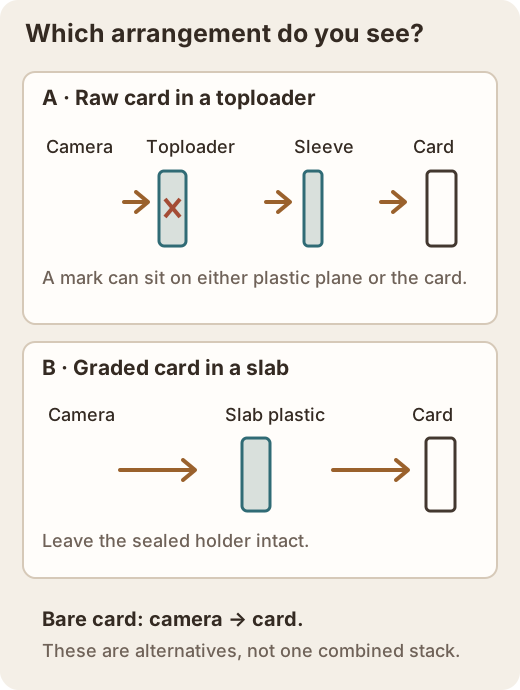
Map the layers before testing
A raw card may be bare, sleeved, or sleeved inside a toploader. A graded card is viewed through a separate sealed holder; it is not the same stack with a slab added on top. Each plastic plane can carry scratches, dust, and reflections, and the card can have marks of its own. Name the arrangement before applying any clue, because the layers you can safely inspect differ.
Take one full image in even light and identify the exact suspect area using card artwork or text as a landmark. A description such as “fine diagonal line crossing the second letter of the name” is easier to compare than “scratch near the middle.” Then take another image after a small change of angle. The moving-light inspection guide covers how to avoid confusing glare with a fixed surface finding.
Change angle and watch relative motion
A mark on an outer plastic plane can shift relative to the printed card art as viewing angle changes. This is a parallax clue: nearby and distant planes do not move identically in the image. Keep the card orientation controlled, move the camera slightly left or right, and compare the mark with the same printed landmark. If the apparent line crosses different letters in the two views, it is less likely to be on the card surface. If the mark stays aligned with the artwork, this test has not identified its layer. Small separations between layers or small changes in viewing angle can make relative movement difficult to see.
Change the camera angle first while the protected card rests still. If you need a second reflection, tilt the entire holder only while supporting it and preventing the card from sliding; stop if the card can move inside. Watch whether a line changes relative to a sleeve seam or holder edge. For a slab, move only the sealed holder or camera. Never open it for this test.
Use focus and reflection as supporting clues
If your camera can focus close, take one image focused on the outer plastic and one focused on printed card detail. A line sharp only when the outer plane is sharp suggests a holder mark; a line that sharpens with the card may be deeper in the stack. Phone autofocus often makes this test weak, especially through glossy plastic, so treat it as supporting evidence, not a verdict. Reflections from overhead light can form straight or curved streaks that move substantially when the holder tilts.
Dust and lint may sit on the outside of a slab, between holder and sleeve, or inside a sleeve. A single dark speck cannot be assigned to a layer just because it appears over the art. A clean-looking outer surface does not rule out inner debris. Avoid blowing into a holder opening, wiping a card, or probing around a sealed case. Do not rub a suspected mark as a diagnostic test; document the view instead.
Decide when removal is appropriate
If an ungraded card is already being removed for another necessary task, a clean workspace and slow handling may allow an unobstructed view. Do not repeatedly insert and remove it solely to chase a faint line. For a seller's card, ask for another view rather than instructing unsafe removal. For a slabbed card, leave the sealed holder intact. A slab scratch can be documented as a holder condition issue without pretending to know the card's underlying surface.
Do not use solvents, abrasive polish, heat, or scraping to “clear” a plastic mark while the card is inside. Those actions can create new problems and are unnecessary for classifying the existing photograph. If the card cannot be safely accessed, your evidence note should preserve the layer uncertainty.
A four-outcome troubleshooting note
- Likely outer holder: the mark shifts against card art, focuses on the outer plane, or changes with an outside-plastic view.
- Likely sleeve or inner plastic: it shifts against card art but stays aligned with a visible sleeve feature; confirm only if safe views allow.
- Likely card surface: it stays fixed to one printed location in several angles and interrupts the card's own reflection.
- Unresolved: one image, poor focus, glare, or inseparable layers do not support localization.
These are evidence labels, not guarantees. A line might be present on both holder and card, and a matching location can be coincidental. If you are buying from a listing, ask for a targeted follow-up photo using the online buying checklist. If the card is yours and the mark can be localized safely, document it in the condition workflow with side and location rather than a grade prediction.